Short answer. No cheat code stops a hurricane. The real-life ones are simpler: know your evacuation zone 4, turn on phone alerts 11, sign up for Miami-Dade Alerts 10, and stay out of floodwater 2. The Atlantic hurricane season runs June 1 to November 30 2, and storm surge, not wind, is the leading cause of hurricane deaths 3. Miami-Dade calls heat the number one weather-related killer 8.
Everyone is typing "GTA 6 cheat codes" tonight. Fair enough: Rockstar Games lists Grand Theft Auto VI as coming November 19, 2026, set in "Vice City, USA", in the fictional state of Leonida, "the sunniest place in America", with Jason and Lucia as its leads 1. Vice City is fiction. The place it makes most players think of, Miami, is not, and its weather does not come with a pause button. Here are the codes that work in the real one.
Phaenyx is not affiliated with Rockstar Games or Take-Two Interactive. The game is named here only to describe the topic.
Spawn point: Miami
You spawn in Miami-Dade County. The county's own description of its hurricanes reads like a boss briefing: destructive winds, torrential rain and life-threatening storm surge, with power and communication failures that may last days, weeks or even months 5. The season runs from June 1 to November 30 2, so on November 18 you are still in it. The county asks you to have your plans and supplies in place before the season begins 5.
No difficulty slider here. But you get to prepare before the level starts. Our hurricane preparedness guide explains watches, warnings and categories.
The map: evacuation zones A to E
Every good open world has a map. Miami-Dade's most important one is the "Know Your Zone" storm surge map 4. Storm Surge Planning Zones cover areas that could see a storm surge of 1.5 feet (about 45 cm) or more 4:
| Zone | At risk of storm surge from 4 |
|---|---|
| A | Category 1 and stronger storms |
| B | Category 2 and stronger storms |
| C | Category 3 and stronger storms |
| D | Category 4 and stronger storms |
| E | Category 5 storms |
Read the fine print, because it matters more than the letter:
- Zones are evacuated according to the hurricane's track and projected surge, independent of its category 4.
- These zones deal only with storm surge, not your flood zone 4.
- Mobile home residents and people on electrically dependent life-sustaining medical equipment should evacuate when any hurricane evacuation order is issued, whatever their zone 4.
- If you live in a mandatory evacuation zone and local officials tell you to leave, do so immediately 2.
Weather events you can't pause
Hurricanes and storm surge
Storm surge is ocean water pushed on shore by a tropical storm or hurricane. Miami-Dade calls it the greatest threat to life and property from a hurricane, and the main reason residents are asked to evacuate 4. The National Hurricane Center (NHC) says storm surge "is currently the leading cause of fatalities from hurricanes", and it can travel up rivers and canals, well inland 3. Water weighs about 1,700 pounds per cubic yard (roughly 1,000 kg per cubic metre), and repeated waves can demolish structures not designed for that force 3.
King tides: the flood on a sunny day
King tides are the highest predicted high tides of the year; in southeast Florida the highest come in the fall 6. They often flood coastal and low-lying streets, and it gets worse when they line up with heavy rain, strong winds or big waves 6. Sea level rise is causing them to happen more frequently, last longer and extend further inland 6. NOAA calls water 0.55 m (1.8 feet) above average high tide "minor" high tide flooding, enough to back up storm drains and close roads 7. Next round: the county lists November 23 to 26, 2026, from South Florida Water Management District dates 6.
Heat
Miami-Dade calls heat "the number one weather-related killer" and estimates an average of 600 excess deaths a year during extreme heat in the county 8. Its Heat Season protocol runs from May 1 to October 31, and days above 90°F (32°C) have risen from 84 to 133 a year since 1970 8. More in our heatwave guide.
Live event: tonight's alerts in South Florida
As of the evening of 18 November 2026, the National Weather Service (NWS) office in Miami had a Flood Watch for Palm Beach, Broward and Miami-Dade counties until 7 p.m. on Thursday 19 November, a High Surf Advisory for the Palm Beach and Broward coasts, a rip current statement for the Palm Beach, Broward and Miami-Dade coasts through Friday evening, and a Wind Advisory for the same three counties until 1 a.m. Thursday 13. The NWS Miami office forecast 2 to 4 inches (50 to 100 mm) of rain along the immediate east coast through Saturday morning, with localized amounts possibly double that 12. Alerts change by the hour: check the NWS Miami page for the current ones 12, stay out of the water while rip currents are forecast (see our dangerous waves guide), and always follow your authorities' instructions.
Real-life cheat codes
No button combo. Just these, all from official sources:
- KNOWYOURZONE. Look up your letter on the county's "Know Your Zone" map before a storm is named 4.
- GOVALERTS. Check that Wireless Emergency Alerts are on. They are free, need no subscription and arrive with a distinctive sound and vibration; some phones call them "Government Alerts" or "Emergency Alert Messages" 11.
- MIAMIDADEALERTS. Activate free Miami-Dade Alerts by text or email from a miamidade.gov account, for NWS tornado, tropical storm and hurricane warnings and other emergencies 10. The county also has the Ready Miami-Dade app for iPhone and Android 5.
- LEAVENOW. In a mandatory evacuation zone, when officials say go, go immediately 2.
- TURNAROUNDDONTDROWN. Do not walk, swim or drive through floodwater: six inches (about 15 cm) of fast-moving water can knock you down, and one foot (about 30 cm) can sweep a vehicle away 2.
- NOATTIC. Trapped by rising water? Go to the highest level of the building, but do not climb into a closed attic 2.
- SWIMPARALLEL. Caught in a rip current: relax and float, it pulls you away from shore, not under. Swim parallel to the shoreline, never straight back against it, and wave for help 15.
- HIGHGROUND. Before king tides, move your car to higher ground; after driving through salt water, rinse it with fresh water 6.
- STAYCOOL. On hot days, get into air conditioning or a cooling site, drink water before you are thirsty, and never leave children or pets in a parked car 9.
- CHECKYOURSQUAD. Check on older adults, young children, people with chronic conditions and outdoor workers when it is hot 9.
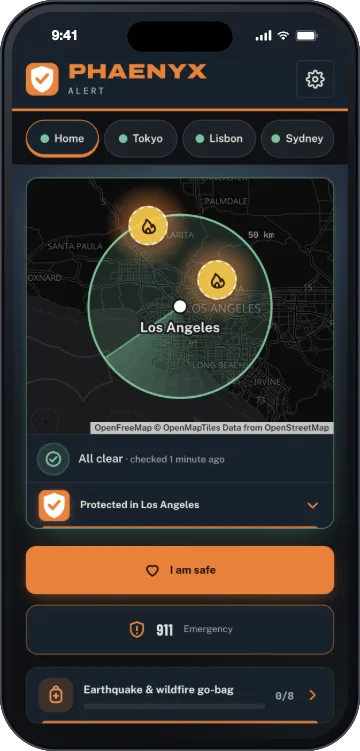
Enable real-life alerts. Got family or friends in Miami? The free Phaenyx Alert app sends you official warnings for the places you choose. It does not replace WEA or local alerts. Travelling from abroad? See emergency alerts abroad and how the United States warns the public.
Your loadout
Ready.gov's basic kit, the starter inventory 14:
- Water: one gallon (about 3.8 litres) per person per day, for several days.
- At least a several-day supply of non-perishable food.
- Battery-powered or hand-crank radio, plus a NOAA Weather Radio with tone alert.
- Flashlight, first aid kit, extra batteries, a whistle.
Miami-Dade adds side quests worth doing: pet preparedness, pruning trees before the season, and a plan for where you would go if you must evacuate 5. Full list in our 72-hour kit guide and the official US emergency supplies.
No respawns
In a game you reload the save. In real life there is no second try, so follow your local authorities' instructions, every time.
Frequently asked questions
Is Vice City a real place?
No. Vice City and the state of Leonida are fictional settings created by Rockstar Games for Grand Theft Auto VI 1. The hazards on this page are those of the real Miami-Dade County, from official sources 4 5.
Do hurricanes hit Miami?
Miami-Dade County plans for them every season: it warns of destructive winds, torrential rain, life-threatening storm surge and outages lasting days to months 5, and draws storm surge zones A to E for Category 1 to Category 5 storms 4. The Atlantic season runs June 1 to November 30 2.
What are the real cheat codes?
Know your evacuation zone 4, keep Wireless Emergency Alerts on 11, sign up for Miami-Dade Alerts 10, leave immediately when told to evacuate 2, never drive through floodwater 2, and swim parallel to shore if a rip current grabs you 15.
Do I need to sign up to get emergency alerts on my phone?
Not for Wireless Emergency Alerts: they are free and need no subscription 11. Miami-Dade Alerts by text or email do need to be activated from a miamidade.gov account 10.
Who do I call in Miami?
In an emergency, call 911. For non-urgent police matters in the City of Miami, see the Miami police non-emergency number, and the United States page for national agencies.
Sources · 15
- Rockstar Games · Grand Theft Auto VI checked 2026-11-18
- Ready.gov (U.S. Department of Homeland Security / FEMA) · Hurricanes checked 2026-11-18
- NOAA National Hurricane Center · Storm Surge Overview checked 2026-11-18
- Miami-Dade County · Storm Surge (Storm Surge Planning Zones, Know Your Zone) checked 2026-11-18
- Miami-Dade County · Hurricanes checked 2026-11-18
- Miami-Dade County · King Tides checked 2026-11-18
- NOAA National Ocean Service · What is high tide flooding? checked 2026-11-18
- Miami-Dade County · Extreme Heat checked 2026-11-18
- Miami-Dade County · Heat Safety Tips checked 2026-11-18
- Miami-Dade County · Sign up for Miami-Dade Alerts checked 2026-11-18
- Ready.gov (U.S. Department of Homeland Security / FEMA) · Emergency Alerts checked 2026-11-18
- U.S. National Weather Service, Miami office · Miami - South Florida (watches, warnings and advisories) checked 2026-11-18
- U.S. National Weather Service · Active alerts for Florida (NWS API) checked 2026-11-18
- Ready.gov (U.S. Department of Homeland Security / FEMA) · Build A Kit checked 2026-11-18
- NOAA National Hurricane Center · Survive a Rip Current checked 2026-11-18